 Visit Mexico City Guide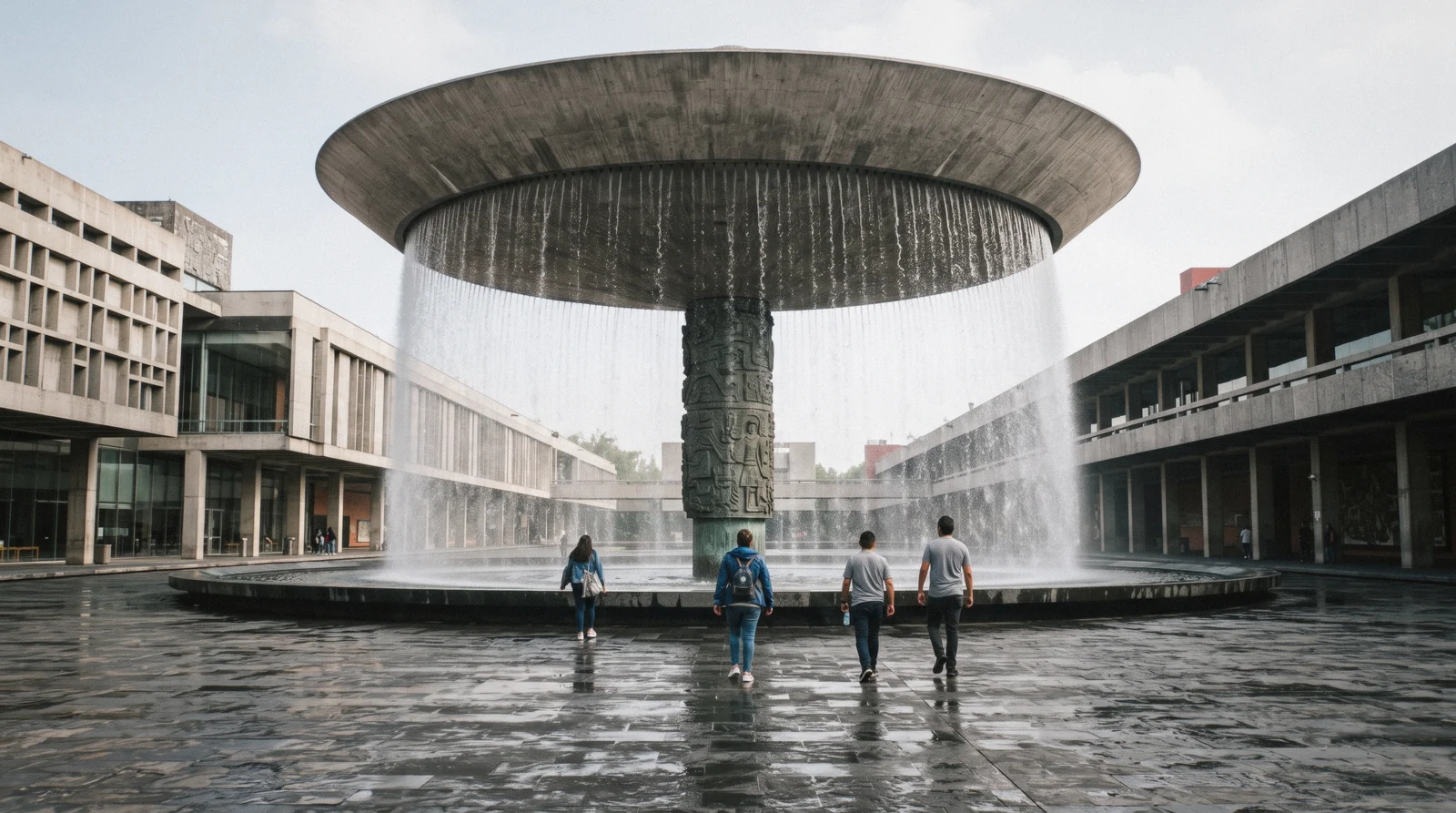
National Museum of Anthropology
The National Museum of Anthropology is the one museum in Mexico City that visitors who dislike museums come out of talking about. Twenty-three halls around a courtyard with a concrete umbrella fountain at its centre, opened in 1964 to Pedro Ramírez Vázquez's design: the ground floor is one hall per civilisation, from the first hunters to the Mexica, and the upper floor is how the descendants of those cultures live now. It opens Tuesday to Sunday, 09:00 to 18:00, and entry is MX$210 for a non-resident foreign visitor — hours and prices read on the museum's own page on 30 August 2026.
Quick answer Hours, price, how long it takes, and what not to miss
The National Museum of Anthropology opens Tuesday to Sunday, 09:00 to 18:00, and closes on Mondays. Entry is MX$210 for a non-resident foreign visitor and MX$105 for Mexican nationals and foreign residents, sold at the window — there is no timed entry and nothing sells out.
Key takeaways
- Twenty-three halls over two floors: the ground floor is the archaeology and the reason to come, the upper floor is living ethnography — our three-hour route covers the first
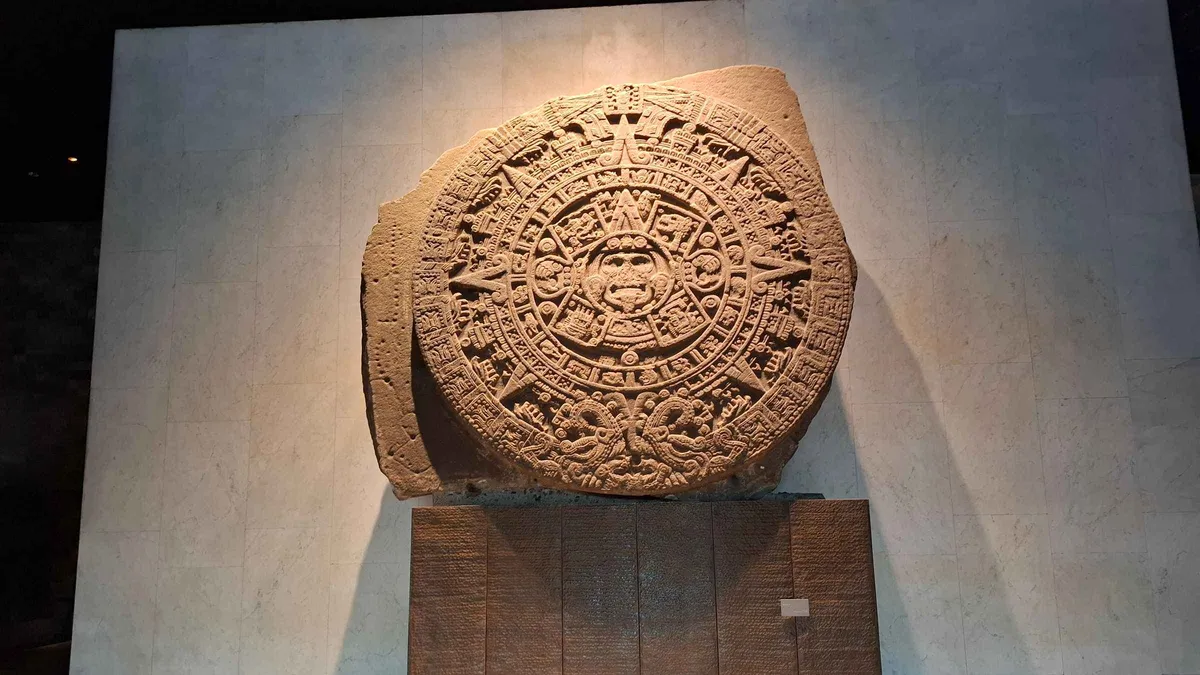
- The Sun Stone is here, in the Mexica hall, not at Teotihuacán or the Templo Mayor — it is the object most people arrive looking for in the wrong place
- The museum publishes no audio guide of its own; a platform ticket with a digital guide lists at $22.61, which is the rare case where the platform undercuts the MX$210 gate price
- It sits at the far end of Chapultepec park from the castle, and the two make one full day — the castle first, because it closes an hour earlier
- It is the first stop this Mexico City guide sends a first-time visitor to, and the one that makes every other Mexica site legible
Key facts
Opening hours
| Tuesday to Sunday, all year | 09:00–18:00 |
|---|
Closed Mondays
Admission
- Adult
- MX$210 (about US$12.35)
- Reduced
- MX$105 Mexican nationals and foreign residents with proof
- Free
- Under 13, disabled visitors, students and teachers with credential, INAPAM over-60s; Sundays for nationals and residents
Planning it
- Time needed
- Not stated by the museum; our routing: 3 hours for the ground floor, a full day to do it justice
- Book ahead
- Optional — walk-up usually fine
- Address
- Av. Paseo de la Reforma s/n, Polanco, Bosque de Chapultepec, 11560 Ciudad de México
What Entry Costs, And Where To Buy It
The museum's own price against the platform listings, all read on 30 August 2026 at US$1 = MX$17.0. The first row is INAH's own ticket and its link carries no tracking of ours; note that here, unusually, one platform card is cheaper than the gate.
| Option | Price | Includes | Cancel | Book |
|---|---|---|---|---|
| INAH ticket, window or official shop | MX$210 foreign / MX$105 resident | All 23 halls, both floors | Not stated by INAH | Official site |
| Entry ticket with a digital guide | Listed at $22.61 | Entry plus a phone guide the museum does not provide | Non-refundable | Check Availability |
| Guided visit, 2.5 hours | Listed at $67 | Entry on most options, licensed guide, transport on some | Free up to 24 hours before | Check Availability |
| With Chapultepec Castle, guided | Listed at $75.65 | Both entries and a guide across the park | Free up to 24 hours before | Check Availability |
Free entry, any nationality, for under-13s, visitors with disabilities and students or teachers with a current credential; Mexicans over 60 with an INAPAM card; and Sundays for Mexican nationals and foreign residents only. INAH's own shop is ventadeboletosenlinea.inah.gob.mx.
Tickets And Guided Visits
Each card links to the operator's own page, where the calendar shows what is still open. Prices as listed on 30 August 2026.
 from $22.61
Mexico City: Anthropology Museum Ticket & Digital Guide
Listing details checked 2026-08-30
Entry ticket with a digital guide on your phone — the museum publishes no audio guide of its own.
Check Availability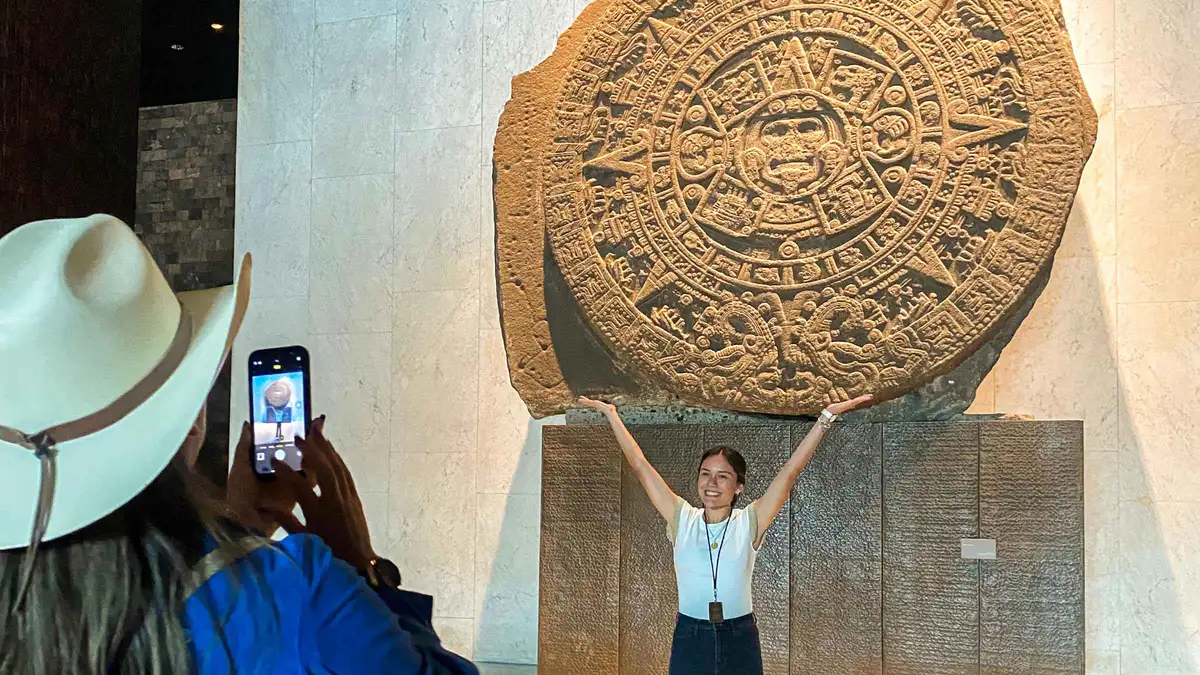 from $67
Mexico City: Anthropology Museum Guided Visit
Listing details checked 2026-08-30
Guided visit through the ground-floor halls with transport, for the museum that rewards a guide most.
Check Availability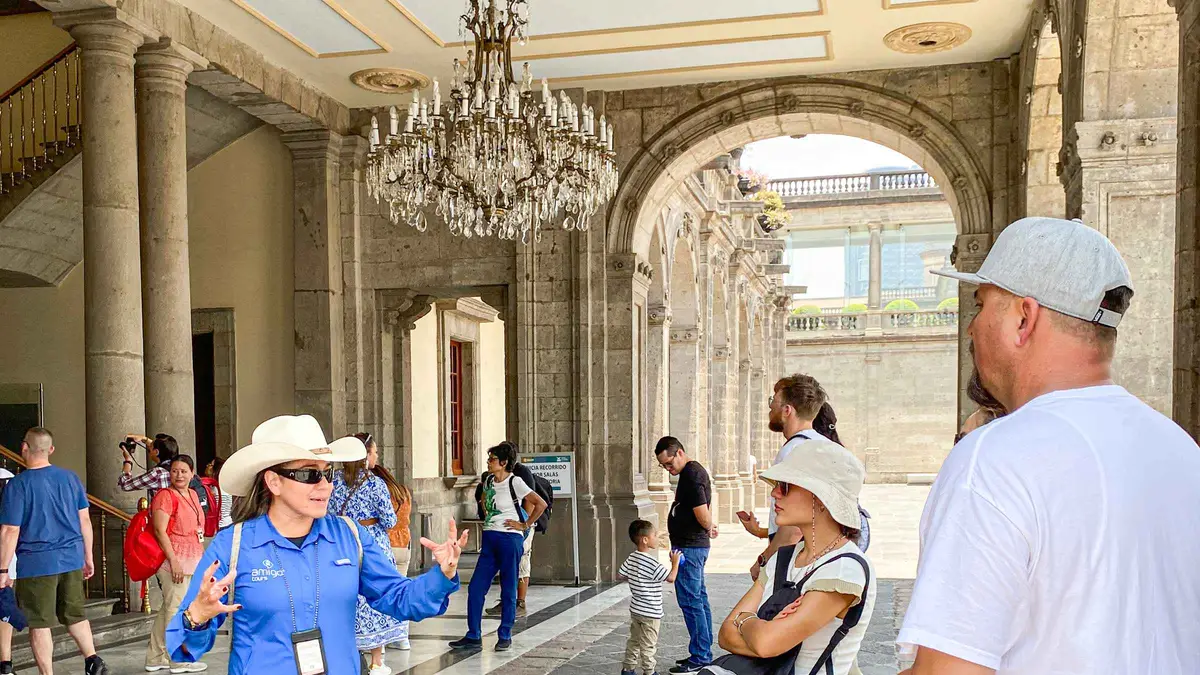 from $75.65
Mexico City: Chapultepec Castle and Anthropology Museum Tour
Listing details checked 2026-08-30
Castle and Anthropology Museum in one guided half day, which is how the two are usually paired.
Check AvailabilityWhat The Building Is, Before What Is In It
The architecture is half the argument here, and it decides how you walk it.
Pedro Ramírez Vázquez's museum opened on 17 September 1964, covering nearly eight hectares. It is built as a rectangle of galleries around one enormous courtyard, and the courtyard is dominated by el paraguas — a vast square concrete canopy held up by a single carved pillar, with water falling from it in a continuous ring. Every route through the museum crosses under it, which is deliberate: the halls open off the courtyard rather than off each other, so you can enter and leave any of them without walking the whole building.
That layout is the practical fact to hold on to. Twenty-three halls in sequence is a route march; twenty-three halls you can dip into from a central courtyard is a museum you can do in three hours without cheating. The ground floor holds the archaeology, arranged by culture and roughly by chronology as you go clockwise; the upper floor holds ethnography — the living cultures of the same regions, directly above their ancestors' rooms.
Eight Things To Find, In Three Hours
Our route, not the museum's — it publishes no suggested visit length and no highlights trail. Clockwise from the entrance, ground floor only.
1. Teotihuacán hall. A full-scale reconstruction of part of the Temple of the Feathered Serpent facade, with its colour restored — the best possible preparation for, or debrief from, the site itself.
2. Toltec hall. The Atlantean warriors from Tula, four metres tall, and the reclining chacmool figures that turn up again everywhere in Mesoamerica.
3. Mexica hall. The big one, straight ahead from the entrance: the Sun Stone on the end wall, the Coatlicue figure, the model of Tenochtitlan's ceremonial precinct that shows exactly what the Spanish built the Zócalo on top of. Give this room a third of your time.
4. Oaxaca hall. Zapotec and Mixtec, with the jade and gold from Monte Albán's Tomb 7 — the finest metalwork in the building.
5. Gulf Coast hall. The colossal Olmec heads, carved from basalt hauled tens of kilometres, and the reason the Olmec are called the mother culture of the region.
6. Maya hall. The largest of them, with the reconstructed tomb of Pakal from Palenque in the basement below it — the jade mask, the sarcophagus lid, the stairway down. Most people find this and the Mexica hall the two they cannot rush.
7. The Maya courtyard. Outside the hall, a reconstructed temple facade and stelae in daylight; the museum's quietest ten minutes.
8. The upper floor, briefly. If you have twenty minutes left, go directly above the Maya hall: the ethnography rooms show textiles, houses and ceremonies of communities living now, and they change how the ground floor reads. Do not attempt the whole floor on a first visit.
The Sun Stone, And Three Objects People Look For In The Wrong Place
Four of the most famous things in Mexican archaeology are in this building, and visitors regularly hunt for them elsewhere.
The Sun Stone — the carved basalt disc, 3.6 metres across, that everyone calls the Aztec calendar — is on the end wall of the Mexica hall here. It is not at Teotihuacán, which predates the Mexica by a thousand years, and it is not at the Templo Mayor, where it was found in 1790 beside the cathedral. Whether it is a calendar at all is disputed; what is agreed is that it was a ceremonial monument, unfinished or abandoned, and that its imagery is about the cycles of creation rather than about dates.
Pakal's tomb from Palenque is reconstructed in the basement of the Maya hall: the jade mosaic mask, the sarcophagus lid whose carving launched a whole genre of nonsense about astronauts, and the stone stairway that led down to it. It is easy to walk past the entrance to the stairs; look for it at the far end of the hall.
The Olmec colossal heads are in the Gulf Coast hall, not in Villahermosa where several others stand outdoors. And the Teotihuacán facade — the Feathered Serpent temple with its colour restored — is the one thing at the site that cannot be seen at the site, because the surviving pigment is here. That is the argument for coming to this museum before the pyramids rather than after.
How Long It Takes, And How To Cut It
The museum states no visit length. These are our routings, from walking it at three different paces.
Three hours is the honest minimum for the ground floor at a pace that lets you stand still in the Mexica and Maya halls. Ninety minutes gets you four rooms and a sense of having been rushed. A full day, with the upper floor and the cafeteria, is what the building is designed for and what almost nobody has time to give it.
| If you have | Do this | Skip | What you lose |
|---|---|---|---|
| 90 minutes | Mexica, Teotihuacán, Maya, Olmec heads | Everything else | The chronology; you get objects without a story |
| 3 hours | The whole ground floor, clockwise | The upper floor | Only the ethnography, which most first visits skip anyway |
| A full day | Ground floor, lunch in the cafeteria, upper floor above the halls you liked | Nothing | Nothing, but few visitors have the day |
| With children | Mexica hall, Olmec heads, the courtyard fountain | The long chronological rooms | Nothing that a child will miss |
Two things that cost time and are worth budgeting: the bag check at the entrance, which is quick but real, and the distance from the metro. The museum is inside the park, a few hundred metres from the gate, and the walk from Auditorio station takes about ten minutes.
The Free Sunday, And Why It Is Not Free For You
The most misreported fact about museums in Mexico, and it applies here more than anywhere.
Since 1 January 2026 INAH has charged two prices — MX$210 for non-resident foreign visitors, MX$105 for Mexican nationals and foreign residents with proof — and the Sunday exemption belongs to the second group only. A visiting foreigner pays MX$210 on a Sunday exactly as on a Tuesday, and shares the halls with the largest domestic crowd of the week. English-language guides that promise a free Sunday at the Anthropology Museum are describing somebody else's entitlement.
What is genuinely free, any day and any nationality: children under 13, visitors with disabilities, and students and teachers with a current credential. Bring the credential if you have one — this is the one exemption a foreign visitor can actually use, and the window does check it. The same rule holds at Chapultepec Castle, Teotihuacán and the Templo Mayor.
Getting There, And The Bag Rule
It is in the park, on Reforma, and the approach matters more than the address.
Metro Auditorio on Line 7 is the nearest station, about ten minutes on foot through the park; Chapultepec on Line 1 puts you at the other end, by the castle, a 25-minute walk away. The Metrobús runs along Reforma and stops outside. Metro fares are MX$5 a trip on the operator's published tariff. An app car from the Centro Histórico takes 25 to 45 minutes depending on the hour; getting around has the full picture.
Large bags and backpacks go through a check at the entrance and may have to be left. Photography without flash is fine throughout; tripods are not. The cafeteria sits off the courtyard and is better than it needs to be, which matters when the alternative is leaving the park.
With The Castle, In One Day
They are two ends of the same park, and the order is not a matter of taste.
Chapultepec Castle closes at 17:00; this museum closes at 18:00. So the castle goes first, at 09:00, while the climb is cool and the terrace is empty, and the museum takes the afternoon. Both charge MX$210 for a foreign visitor, so the day costs MX$420 in entries, or you can take the guided pairing at $75.65, which covers both entries and a licensed guide.
Two kilometres of park path separate them, or the park's electric train covers part of the distance for MX$40. Both close on Monday, which is why the Monday page exists and why Teotihuacán belongs on that day.
| Castle | This museum | The day | |
|---|---|---|---|
| Opens | 09:00 | 09:00 | Castle first |
| Closes | 17:00 | 18:00 | The reason the order is fixed |
| Entry, foreign visitor | MX$210 | MX$210 | MX$420 for the pair |
| Entry, national or resident | MX$105 | MX$105 | MX$210 for the pair |
| Guided pairing | From $75.65 | Included | Both entries and a guide |
Anthropology Museum Map: Entrance, Metro And The Park
The museum, the two metro stations that serve it, the Metrobús stop on Reforma and the castle at the other end of the park.
Next Stop From The Museum
Walk minutes are our estimates from the GPS distances.
Chapultepec Castle
The other MX$210 ticket in this park. It closes at 17:00, an hour before the museum, so the castle goes first in the day.
25 min walk across the parkPolanco
Lunch after the halls, and the district most visitors who stay near the park sleep in.
12 min walk northTemplo Mayor
The Mexica capital's own excavated temple, beside the Zócalo — the museum's Mexica hall makes far more sense after it, or before.
25 min by metroAnthropology Museum Questions
How much does it cost to go to the Museum of Anthropology?
MX$210 for a non-resident foreign visitor, about US$12.35, and MX$105 for a Mexican national or foreign resident with proof. Children under 13, visitors with disabilities and students or teachers with a current credential enter free, any nationality. A platform ticket with a digital guide lists at $22.61, which is close to the gate price and adds the audio the museum does not provide.
Is the National Museum of Anthropology free entrance?
Not for most visitors. Sunday entry is free for Mexican nationals and foreign residents only — since INAH's 2026 tariff, a visiting foreigner pays MX$210 on Sundays as on any other day. The genuinely nationality-blind free bands are under-13s, visitors with disabilities, and students and teachers with a valid credential. The Sunday rule is set out above.
How much time should I spend at the Anthropology Museum?
The museum states no visit length; our routing is three hours for the ground floor at a pace that lets you stop in the Mexica and Maya halls, and a full day if you want the ethnography upstairs too. The table above shows what to cut at 90 minutes.
What is the National Museum of Anthropology known for?
The Sun Stone in the Mexica hall, the colossal Olmec heads, the reconstructed tomb of Pakal from Palenque, the Teotihuacán facade with its colour restored — and the building itself, Pedro Ramírez Vázquez's 1964 design with the concrete umbrella fountain in the courtyard. The eight-stop route covers them in order.
Is the Anthropology Museum open on Mondays?
No, it closes every Monday, as do Chapultepec Castle and the Casa Azul. Teotihuacán is open daily, which is why it belongs on the Monday of a four-day trip.
Do I need to buy tickets in advance for the Anthropology Museum?
No. There is no timed entry and no capacity problem a visitor is likely to meet: buy at the window, or on INAH's own shop at ventadeboletosenlinea.inah.gob.mx if you would rather pay in advance. The only reason to buy through a platform is the digital guide, since the museum publishes no audio guide of its own.
Where This Fits In A Day
It is an afternoon, and it deserves to be the last thing you do that day.
Castle at 09:00, walk the park, lunch in Polanco or at the museum's own cafeteria, and the halls from about 13:00 until closing at 18:00 — that is the whole of day two in the two-day itinerary and it works because nothing after a museum of this size is going to land anyway.
If you can only fit one big museum into a short trip, make it this one and see it before Teotihuacán rather than after: the Teotihuacán hall here explains what you will be standing on, and the site itself has no equivalent display.
The rest of the trip around it — what else a four-day visit holds, and in what order — is on the Mexico City city guide.
The Halls On Film
Three walk-throughs that show the scale of the building and the objects worth planning around.
Visiting Mexico City's National Museum of Anthropology
A visitor's route through the main halls, including the Sun Stone.
Video: Jay and HimaniEnormous museum in Mexico
The size of the place, and how long it really takes.
Video: Eileen AldisNational Museum of Anthropology — guided tour, part 1
A guided pass through the archaeology halls.
Video: Finkworld TravelsVideos load from YouTube only when you press play.
Page last reviewed 2026-08-30. Prices, hours and terms are set by the venue or operator and confirmed at checkout.
We may earn a commission if you book through one of our links, at no extra cost to you. Full affiliate disclosure