 Visit Mexico City Guide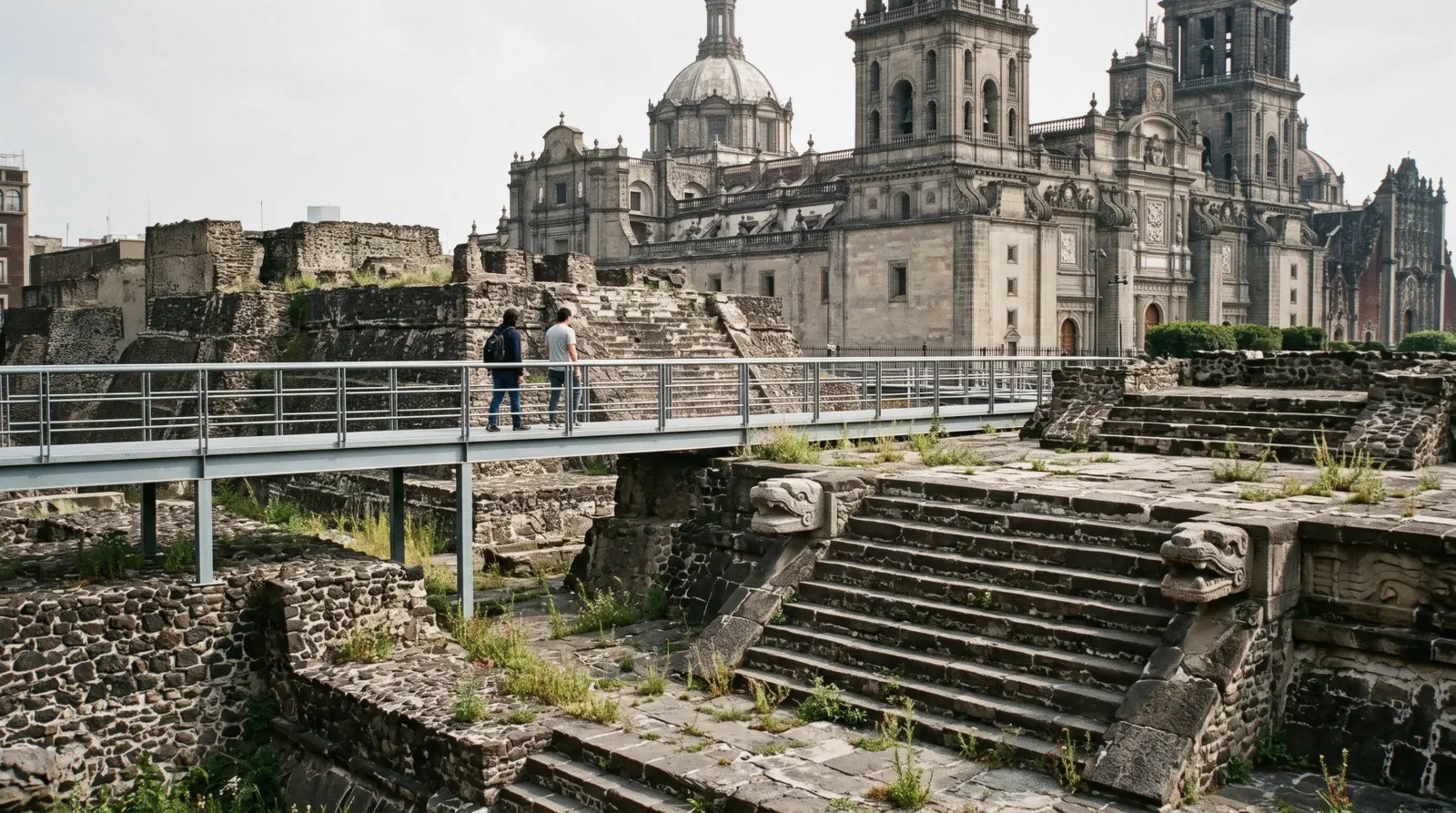
Templo Mayor
The Templo Mayor was the great temple of Tenochtitlan, the twin-shrined pyramid at the centre of the Mexica world, and for four and a half centuries nobody knew exactly where it was. In February 1978 an electricity crew digging behind the cathedral hit a carved stone disc eight tonnes in weight — the dismembered goddess Coyolxauhqui — and the block above it was cleared to reveal the temple's stacked rebuildings. It opens Tuesday to Sunday, 09:00 to 17:00, and the museum behind the ruins holds what came out of the ground.
Quick answer What it is, what it costs, and why the museum matters more than the ruins
The Templo Mayor is the excavated base of the Mexica great temple, on the north-east corner of the Zócalo, open Tuesday to Sunday from 09:00 to 17:00 and closed on Mondays. The site is a raised walkway over stacked platforms; the museum behind it holds the Coyolxauhqui stone and everything else the excavation produced.
Key takeaways
- Allow two hours for both halves — the ruins take 40 minutes and the eight-room museum takes longer than anyone expects
- It sits two minutes from the Zócalo and the cathedral, which makes the three of them one morning
- The temple was not destroyed by time: Cortés ordered the Mexica capital demolished in 1521 and the cathedral was built from its stone
- Entry follows INAH's 2026 two-tier tariff — MX$210 for a foreign visitor, MX$105 for nationals and residents — with one caveat about our source
- Where it sits in a first day is set out on the independent Mexico City guide
Key facts
Opening hours
| Tuesday to Sunday | 09:00–17:00 |
|---|
Closed Mondays, closed for maintenance per INAH
Admission
- Adult
- MX$210 (about US$12.35) under INAH's 2026 Category I tariff
- Reduced
- MX$105 Mexican nationals and foreign residents with proof
- Free
- Under 13, disabled visitors, students and teachers with credential, INAPAM over-60s; Sundays for nationals and residents
Planning it
- Time needed
- Not stated by the museum; our routing: 2 hours for the ruins and the museum together
- Book ahead
- Optional — walk-up usually fine
- Address
- Seminario 8, Centro Histórico, 06060 Ciudad de México
A Note On The Price
This guide prints the source of every figure, and this one has an asterisk worth stating plainly.
INAH's own museum page for the Templo Mayor returned a server error to us on 30 August 2026, and the museum's dedicated site, templomayor.inah.gob.mx, serves an expired security certificate. What we could read is INAH's hours for the site — Tuesday to Sunday 09:00 to 17:00, closed Mondays for maintenance — and the institute's 2026 tariff, which puts Category I museums and zones at MX$210 for non-resident foreign visitors and MX$105 for Mexican nationals and residents, the same band as Teotihuacán, the Anthropology Museum and Chapultepec Castle.
So the price here is the tariff for the category, not a figure read on the museum's own page. Older listings still show MX$100, which predates the 2026 reset. Take cash for the difference and check the board at the booth; when the museum's own page answers again, this paragraph will be replaced with a direct citation.
| Figure | Value | Source we could read | Status |
|---|---|---|---|
| Hours | Tue–Sun 09:00–17:00 | INAH | Read |
| Closed | Mondays, for maintenance | INAH | Read |
| Foreign visitor | MX$210 | INAH 2026 Category I tariff | Tariff, not the museum's page |
| National or resident | MX$105 | INAH 2026 Category I tariff | Tariff, not the museum's page |
| Older listings | MX$100 | Third-party sites | Superseded on 1 January 2026 |
What Entry Costs
INAH's 2026 Category I tariff, converted at US$1 = MX$17.0, beside the guided options that include this site. The first row is the official shop and its link carries no tracking of ours.
| Option | Price | Includes | Cancel | Book |
|---|---|---|---|---|
| INAH ticket, booth or official shop | MX$210 foreign / MX$105 resident | The excavation walkway and the site museum | Not stated by INAH | Official site |
| Historic-centre walking tour | Listed at $27.01 | Three hours on foot around the Zócalo; entries not included | Free up to 24 hours before | Check Availability |
| Centro food tour, seven tastings | Listed at $88.10 | The streets around the site, with the eating explained | Free up to 24 hours before | Check Availability |
No platform sells a Templo Mayor entry ticket in this guide's checks — the booth on Calle Seminario and INAH's own shop, ventadeboletosenlinea.inah.gob.mx, are the ways in.
Walking The Centre Around It
Guided options that cover the streets around the temple. Prices as listed on 30 August 2026.
 from $27.01
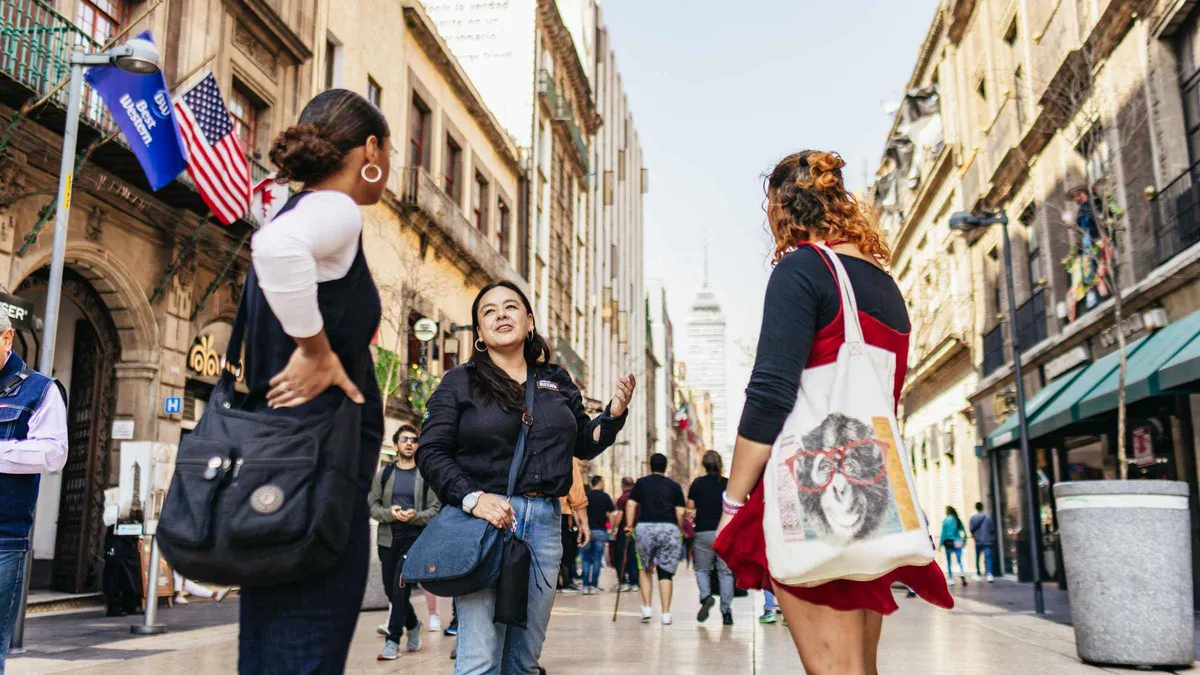
Mexico City: Historic Downtown Walking Tour
Listing details checked 2026-08-30
Three hours on foot through the Zócalo, Bellas Artes and the streets between them, with the history attached.
Check Availability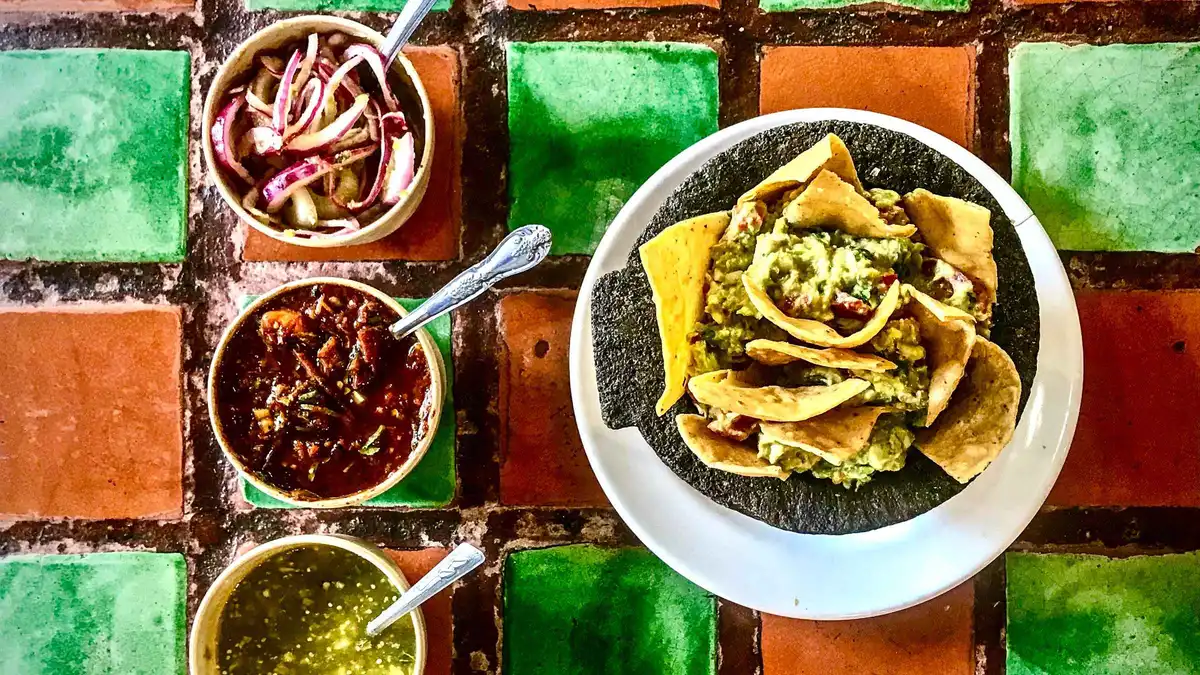 from $88.10
Mexico City: Old Town Food Tour of 7 Tastings & Secret Dish
Listing details checked 2026-08-30
Seven tastings through the Centro Histórico, ending with you able to order for yourself.
Check Availability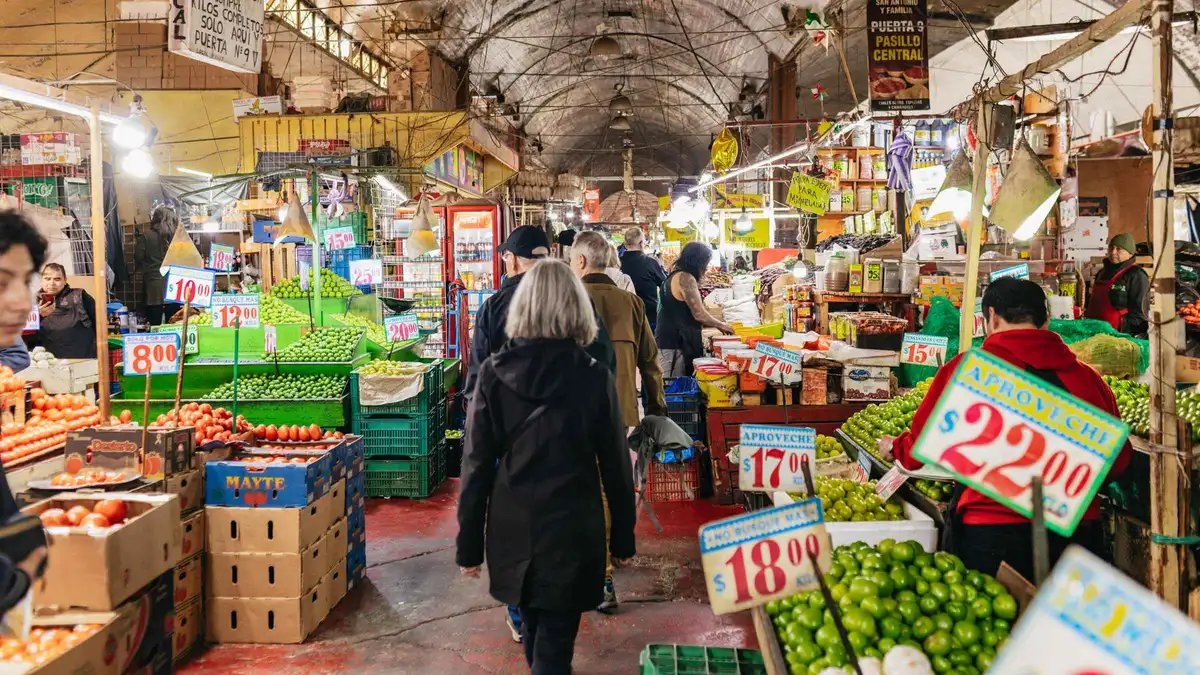 from $88.05
Mexico City: Local Food Tour at Mexico’s 2nd Largest Market
Listing details checked 2026-08-30
A market morning through La Merced and Sonora, the city's second-largest market complex.
Check AvailabilityWhat The Templo Mayor Was
One pyramid, two shrines, seven rebuildings, and a foundation myth built in stone.
The Mexica built their capital, Tenochtitlan, on an island in Lake Texcoco from 1325, and this temple stood at the centre of its sacred precinct. It was a single stepped pyramid carrying two shrines: Huitzilopochtli, the war and sun god who had led the Mexica to the island, on the south side, and Tlaloc, the rain god, on the north. Two gods, two staircases, one structure — an arrangement no other Mesoamerican capital used at this scale.
Seven temples inside one
Mesoamerican practice was to rebuild over the old structure rather than replace it, and the Mexica did so at least seven times between about 1325 and 1519, each shell enclosing the last. That is what you are walking over: not one ruin but a cross-section of them, with the earlier stages better preserved because they were buried. The painted shrine walls that survive are from stage II, and they survive because a later temple sealed them.
Coyolxauhqui, and the story the stone tells
The disc the electricity crew found in 1978 shows Coyolxauhqui, dismembered — the sister Huitzilopochtli killed at the moment of his birth, in the myth, and threw down the mountain. The stone lay at the foot of the temple stairway, so that bodies thrown down the steps landed on the image of the dismembered goddess: the myth re-enacted at the point of sacrifice. Once you know that, the whole layout reads as an argument rather than a building.
Who Destroyed It, And What Happened To The Stone
The short answer is Cortés, and the longer answer is standing on the north side of the square.
Tenochtitlan fell in August 1521 after a siege of nearly three months. Cortés ordered the ceremonial precinct levelled and the city rebuilt as the capital of New Spain on the same footprint — not beside the Mexica capital but on it. Temple stone went into the new buildings, and the cathedral that stands a hundred metres from this excavation is partly built from the temple it replaced.
The precinct then vanished under four centuries of colonial and modern city. Fragments surfaced repeatedly — the Sun Stone and the Coatlicue in 1790, both now in the Anthropology Museum — but the temple's location stayed uncertain until 1978. The excavation that followed demolished several buildings above it, which is why the site sits in a pit below street level, with the modern city standing at its edges.
What To See: The Walkway, Then The Museum
Forty minutes outside and an hour and a half inside, in that order — the museum makes sense of what you have just walked over.
The walkway. A raised metal path takes you around and over the platforms, past the twin stairways, the serpent heads at their base, the tzompantli platform where skulls were displayed, and the House of the Eagles with its painted benches. Everything is open to the sky and there is no shade; in the rainy season the walkway is slick.
The eight halls of the museum
The museum behind the ruins is organised by theme rather than chronology, and the Coyolxauhqui disc has a room built around it, seen from a gallery above. Elsewhere: the offerings buried in the temple's stages — obsidian, coral, jaguar and eagle skeletons, objects sent as tribute from as far as the Gulf and the Pacific — and the great eagle-warrior ceramic figure from the House of the Eagles.
The 2006 monolith
Tlaltecuhtli, the earth deity, was found in 2006 a few metres from the site: a four-metre carved monolith, the largest Mexica sculpture yet recovered, lifted and restored in view of the public over several years. It is displayed on the museum's ground floor, and the excavation that produced it is still running — this is one of the few sights in the city where the archaeology has not finished.
Practical Notes
Five things that shape a visit here.
No shade. The ruins are open ground and the walkway has no cover. In the dry season the light is fierce by eleven; in the rainy season the afternoon shower arrives about four.
The walkway is not flat. Steps, ramps and metal grating over the platforms, with drops on both sides. Sensible shoes; the museum itself is level and lifts serve its floors.
Entrance on Calle Seminario. The booth is on the street side, not on the square — walk round the cathedral's east end and look for the fenced pit.
Photography without flash is normal practice; tripods are not.
Closed Mondays for maintenance, in INAH's own words, and on the public holidays that close all federal museums. The Monday page has the alternatives.
Templo Mayor Map: Entrance, Ruins And What Is Next Door
The site entrance on Seminario, the excavation, the museum, and the two things two minutes away.
Next Stop From The Templo Mayor
Walk minutes are our estimates from the GPS distances.
Zócalo
The square the temple stood beside, with the cathedral built from its stone and the Palacio Nacional murals on the far side.
2 min walkNational Museum of Anthropology
Where the Sun Stone and the Coatlicue went after they were found here in 1790 — the Mexica hall is the sequel to this site.
30 min by metroPalacio de Bellas Artes
Murals, marble and MX$95, free on Sundays to everyone — the natural second half of a Centro morning.
12 min walk westTemplo Mayor Questions
What was the Templo Mayor?
The great temple of Tenochtitlan: a stepped pyramid carrying two shrines, one to Huitzilopochtli and one to Tlaloc, at the centre of the Mexica sacred precinct. It was rebuilt at least seven times between about 1325 and 1519, each stage enclosing the last, which is what the excavation exposes. The full account is above.
Who destroyed the Templo Mayor?
Hernán Cortés, after Tenochtitlan fell in August 1521: the ceremonial precinct was levelled and the Spanish capital rebuilt on the same ground, using the temple's stone. The Metropolitan Cathedral a hundred metres away is partly built from it. The longer answer covers what happened to the site afterwards.
What did they find at the Templo Mayor?
The excavation began after an electricity crew hit the eight-tonne Coyolxauhqui disc in February 1978. Since then: thousands of buried offerings — obsidian, coral, jaguar and eagle skeletons, tribute objects from the Gulf and the Pacific — the eagle-warrior figure from the House of the Eagles, and in 2006 the four-metre Tlaltecuhtli monolith, the largest Mexica sculpture yet recovered. Most of it is in the museum behind the ruins.
How long do you need at the Templo Mayor?
The museum publishes no figure; our routing is two hours for both halves — about 40 minutes on the walkway over the ruins and the rest in the eight-room museum, which is the part visitors underestimate.
How much does the Templo Mayor cost?
MX$210 for a non-resident foreign visitor and MX$105 for Mexican nationals and residents under INAH's 2026 Category I tariff. We flag this figure honestly: the museum's own pages did not load for us on 30 August 2026, so it is the institute's tariff for the category rather than a price read at source. Older listings showing MX$100 predate the 2026 reset.
Is the Templo Mayor worth visiting?
If the Mexica interest you at all, it is the one place where their capital is physically present rather than described — and the museum is better than the ruins. If you have only one Mexica stop in the city, the Anthropology Museum has the greater objects; this has the ground they came out of.
Where This Fits In A Day
First thing, on a Centro morning, and before the Anthropology Museum rather than after.
Open the day on the Zócalo at eight, be at the Seminario booth when it opens at nine, and give two hours to the ruins and the museum. From there the cathedral and the Palacio Nacional murals fill the rest of the morning, and the walk west to Bellas Artes takes twelve minutes.
One ordering note that improves both visits: see this before the Anthropology Museum. The Mexica hall there holds the Sun Stone and the Coatlicue, both found in this precinct, and they land differently once you have stood over the foundations they came from. The whole first day is laid out on the one-day itinerary, and the trip around it on the Mexico City city guide.
The Excavation On Film
Three walk-throughs of the site and the museum, which show the scale better than a plan does.
Mexico City travel guide 2026
Includes the Centro and the excavation beside the cathedral.
Video: Martijn Around The WorldMexico City tips for first timers
Practical context for a first day in the Centro.
Video: Happy to WanderHow to travel CDMX
Getting to the Zócalo and the temple on the Metro.
Video: Wanderlust WellmanVideos load from YouTube only when you press play.
Page last reviewed 2026-08-30. Prices, hours and terms are set by the venue or operator and confirmed at checkout.
We may earn a commission if you book through one of our links, at no extra cost to you. Full affiliate disclosure