 Visit Mexico City Guide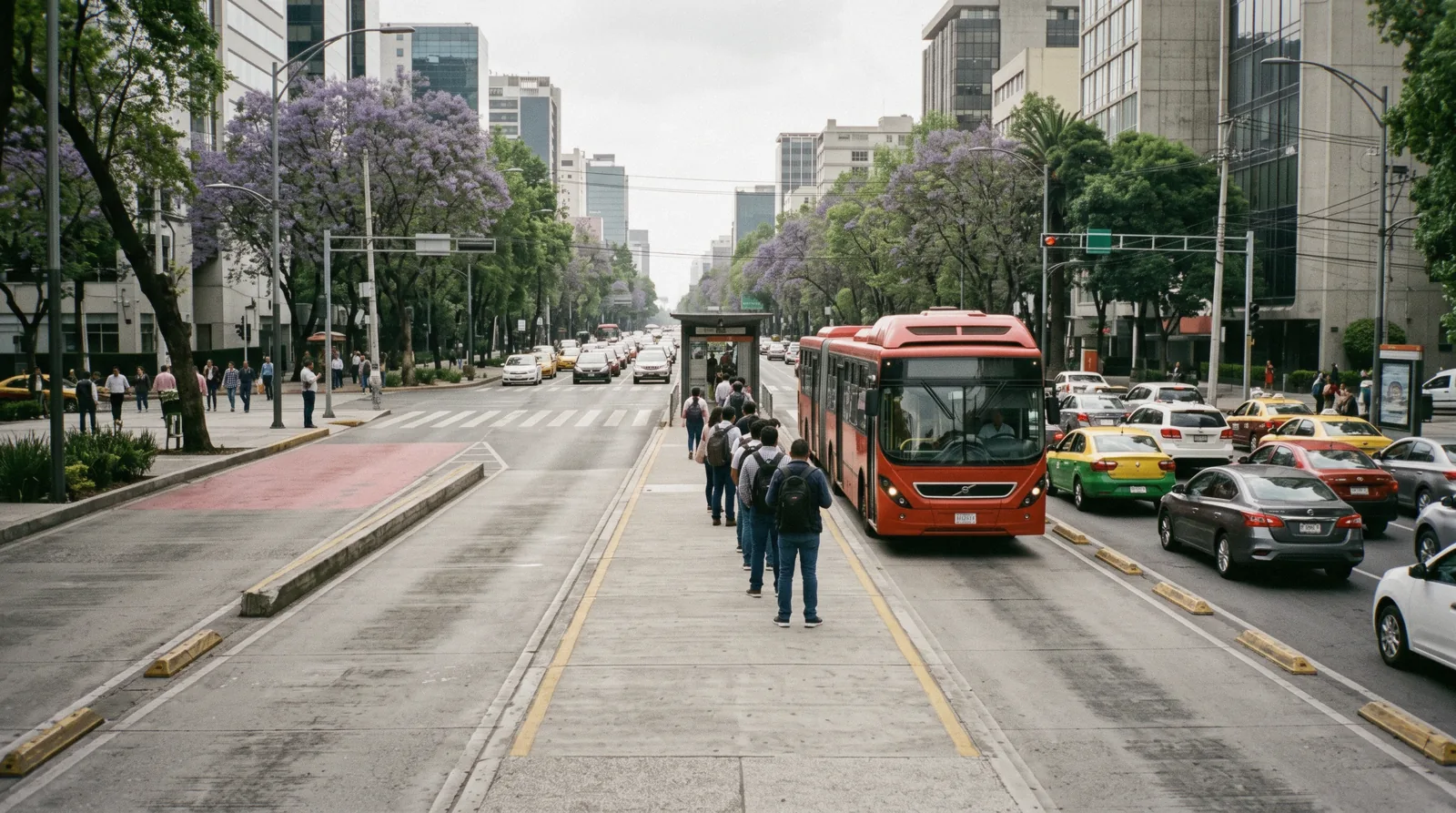
Getting Around Mexico City
Getting around Mexico City is cheap and, at the wrong hour, slow: the Metro costs a few pesos and crosses the centre faster than anything on wheels, the Metrobús owns its own lane down the two main avenues, and an app car is worth it at night, in the rain and with luggage. This page sets out what each mode costs, when it wins, and where those fares come from — which matters here, because the city's own transport websites refuse every request we make to them.
Quick answer What each mode costs and when to use it
The Metro is MX$5 a trip with free transfers, the Metrobús MX$6, the Cablebús MX$7 and the Tren Ligero MX$3, all paid with the same Movilidad Integrada card. An app car across the centre costs 20 to 40 times that and is worth it at night, in the rain, and with bags.
Key takeaways
- Buy a Movilidad Integrada card — about MX$15 plus your first top-up — at a station machine on arrival; it covers every mode above
- From the airport, Metrobús Line 4 costs MX$30 and runs 04:30 to midnight to Terminal 1 gate 7 and Terminal 2 gate 2
- Use the Metro for the Centro, Coyoacán and the Basílica; use app cars after dark and to Xochimilco
- Every fare on this page is the operator's published tariff carried by the Mexican press, not a page we could read — the city's transport sites block us
- How the fares shape a four-day trip is on the independent Mexico City guide
Where These Fares Come From
This guide prints its sources, and on this page the sourcing needs saying out loud.
Every host we need for this page — metro.cdmx.gob.mx, metrobus.cdmx.gob.mx, semovi.cdmx.gob.mx — refused every request from our tools on 30 August 2026, connection closed rather than page missing. So the fares below are the operators' published 2026 tariffs as carried by the Mexican press and by the city's own announcements, not figures we read at source.
They are stable — the Metro fare has not moved in years — and they are consistent across every outlet that reports them. Treat them as reliable and check the board at the station, which is what you would do anyway. When the operators' sites answer us again, this section will be replaced with direct citations.
Every Way To Move, Priced
Six modes, and the column that matters is the last one.
The pattern is simple: rails and dedicated lanes beat cars in the day, and cars beat everything at night.
| Mode | Fare | Hours | Where it wins | Where it fails |
|---|---|---|---|---|
| Metro | MX$5, transfers free | 05:00–00:00 weekdays; later start at weekends | Centro, Coyoacán, the Basílica — end to end in under an hour | Rush hour, luggage, late night |
| Metrobús | MX$6 | 04:30–00:00 | Insurgentes and Reforma; the airport line | East–west journeys off those corridors |
| Cablebús | MX$7 | Daily, daytime | The cable-car lines over the hillside boroughs | It goes where visitors rarely need to |
| Tren Ligero | MX$3 | Daily | Tasqueña to Xochimilco | Only that one corridor |
| Uber / Didi | Metered | 24 h | Nights, rain, bags, Coyoacán to Xochimilco | Weekday afternoons in traffic |
| On foot | Free | — | Centro, Roma, Condesa, Coyoacán — each is walkable | Between districts; they are kilometres apart |
The card. Movilidad Integrada, about MX$15 plus your first top-up, sold at machines in Metro and Metrobús stations. It works on all four public modes. Machines take cash and, at newer stations, cards; keep a MX$50 note for the first one.
The Metro, In Practice
Twelve lines, colour-coded and picture-coded, and the cheapest urban transport in any large capital.
Lines are known by number and colour, and every station has a pictogram as well as a name — a grasshopper for Chapultepec, a cannon for Balderas — a system designed in 1969 for a city where many riders could not read. It is still the fastest way to navigate: match the picture, not the word.
The lines a visitor uses. Line 2 for the Zócalo and the Centro. Line 1 for Chapultepec and Balderas. Line 3 for Coyoacán — 20 minutes' walk from the village centre.
Line 7 for Polanco and the Anthropology Museum at Auditorio. Line 6 for the Basílica. Tren Ligero from Tasqueña for Xochimilco.
The rules that matter. Avoid 07:00–09:00 and 18:00–20:00, when carriages are full in a way that is hard to describe politely. The front carriages are reserved for women and children at busy times and this is enforced. Keep bags in front of you: pickpocketing on the Metro is the most reported petty crime in the city, and it happens in the crush at the doors.
Large luggage is not allowed on the Metro — take the Metrobús or a car from the airport.
Airport To City, And Back
Four options from AICM, and the one that surprises people.
Metrobús Line 4 costs MX$30, runs from 04:30 to midnight, and connects the airport to Buenavista, the Centro Histórico, TAPO and Paseo de la Reforma. It sets down at Terminal 1 gate 7 and Terminal 2 gate 2, and the same MX$30 covers the inter-terminal service the Metrobús has run since 1 August 2026. It takes luggage, which the Metro does not.
| From the airport | Cost | Time to the Centro | Note |
|---|---|---|---|
| Metrobús Line 4 | MX$30 | 45–70 min | Takes luggage; 04:30–00:00; T1 gate 7, T2 gate 2 |
| Authorised airport taxi | Fixed by zone, bought at a counter inside | 30–60 min | Buy the ticket at the desk, not from a tout |
| Uber / Didi | Metered | 30–60 min | Pick-up points are signposted; confirm the plate |
| Metro Line 5, Terminal Aérea | MX$5 | 50–80 min | Cheapest, and officially no large luggage — not the arrival option |
The one rule at arrivals: buy a taxi at an official counter inside the terminal, or use an app from the signposted pick-up point. Ignore anyone offering a ride in the hall — the safety page has the rest of what the advisories say about transport.
App Cars, Street Taxis And When To Use Which
The clearest rule in this guide, and it comes from every consular source and every resident.
Use an app. Uber and Didi both work across the city, both show the driver and the plate before you get in, and both leave a record. Confirm the plate against the app before opening the door. Do not hail a taxi in the street. The advice is consistent from consulates, from residents and from every guide worth reading; if you need a taxi rather than an app, use a sitio rank with a phone number, or have a restaurant call one.
When a car is worth it: after dark, in the rain, with luggage, between districts that no single line connects, and for Xochimilco, where the pier is a long way from anything. When it is not: weekday afternoons in the centre, when the Metro is twice as fast and a twentieth of the price.
Walking, Cycling And The Sunday Closure
Three things that make this city more walkable than its size suggests.
Each district a visitor uses is walkable inside itself: the Centro is flat and largely pedestrianised along Madero, Roma and Condesa are laid out for strolling, Coyoacán is a village. What is not walkable is the space between them — the city is 60 km across and the districts are kilometres apart.
EcoBici, the city bike-share, covers the central districts and takes short-term passes; the bike lanes on Reforma and in Condesa are genuine ones. And on Sundays, Paseo de la Reforma closes to cars until 14:00 for the Muévete en Bici programme, which is the single most pleasant way to see the avenue — bikes, skaters, families and no traffic from the Centro to Chapultepec.
Two practical notes: the pavements are uneven everywhere, cracked by tree roots and by the subsidence, so flat shoes matter more than they would elsewhere; and at 2,240 m an uphill walk is more work than it looks — the altitude page covers what that does on a first day.
When A Tour Solves The Transport
Where the getting there is the product rather than the guiding. Prices as listed on 30 August 2026.
 from $68
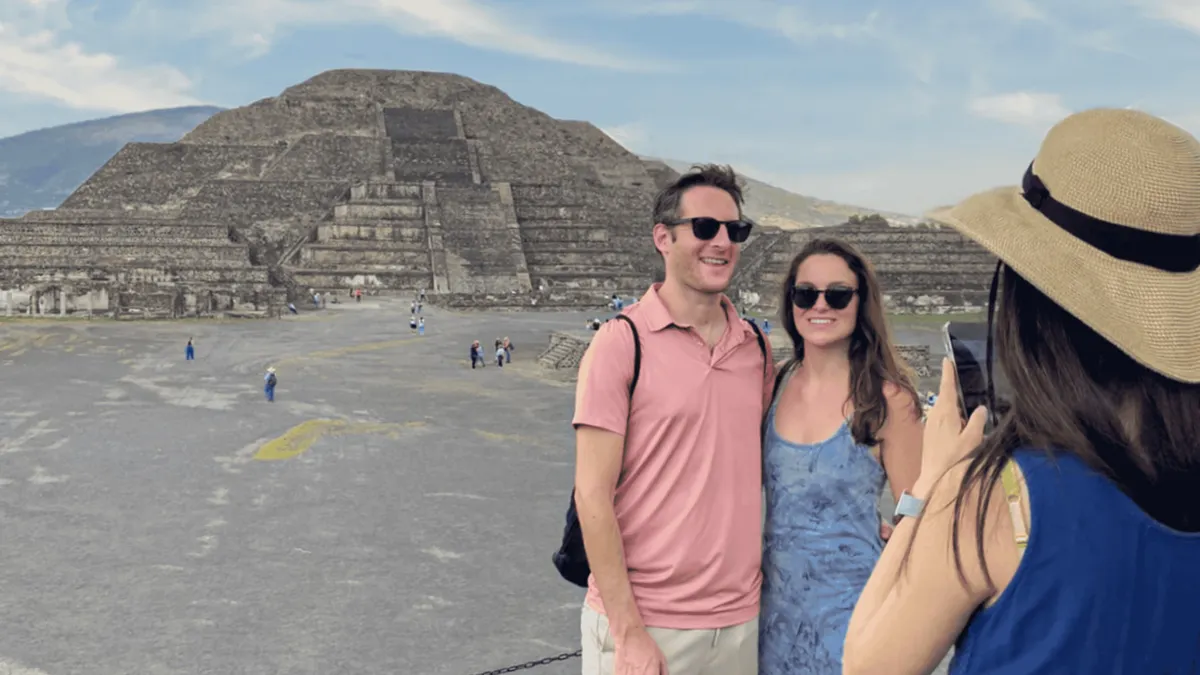
Mexico City: Teotihuacan Early Access Tour & Optional Lunch
Listing details checked 2026-08-30
Early access at the gate before the coaches arrive, with transport from the centre and a licensed guide.
Check Availability from $68
Mexico City: Teotihuacan & Guadalupe Shrine Tour with Lunch
Listing details checked 2026-08-30
Full day to the pyramids with the Basílica de Guadalupe and lunch — the version most first visits take.
Check Availability from $41.51
Xochimilco: Traditional Boat Sightseeing Tour, Culture and Fun.
Listing details checked 2026-08-30
A place on a shared trajinera with a guide, instead of negotiating a MX$750 boat at the embarcadero.
Check AvailabilityThe Pages This One Feeds
Transport decides most of the practical planning; these are the pages that use it.
Getting Around Mexico City: Questions
How much is the Metro in Mexico City?
MX$5 a trip, with transfers between the twelve lines included, paid from a Movilidad Integrada card that costs about MX$15 plus your first top-up. The Metrobús is MX$6, the Cablebús MX$7 and the Tren Ligero MX$3. Every one of those figures is the operator's published tariff as reported rather than read — the sourcing note explains why.
How do I get from Mexico City airport to the centre?
Metrobús Line 4 for MX$30, which runs 04:30 to midnight, takes luggage and stops at Terminal 1 gate 7 and Terminal 2 gate 2; an authorised taxi bought at a counter inside the terminal; or an app car from the signposted pick-up point. The Metro is MX$5 but officially refuses large luggage. The comparison is above.
Is the Mexico City Metro safe for tourists?
It is used by millions of people a day and it is the fastest way across the centre. The realistic risk is pickpocketing in the crush at the doors, which is the most reported petty crime in the city — keep bags in front of you and avoid 07:00–09:00 and 18:00–20:00. The women-and-children carriages at the front are enforced at busy times.
Should I use Uber in Mexico City?
Yes, or Didi — both work everywhere and both show the driver and plate before you get in. The consistent advice from consular sources and residents alike is not to hail taxis in the street; if you need one, use a sitio rank or have a restaurant call it. Cars are worth it at night, in the rain and with bags.
Do I need a car in Mexico City?
No, and a car is close to a liability: traffic is heavy, parking is scarce and expensive, and the districts a visitor uses are connected by Metro and Metrobús. Hire one only for a day trip that public transport does not reach well — and even for Teotihuacán, the coach from Terminal Norte is easier.
What is the Movilidad Integrada card?
The city's single transport card, about MX$15 plus your first top-up, sold at station machines. It covers the Metro, Metrobús, Cablebús, Tren Ligero and trolleybus, so one card handles every public journey in this guide. Buy it on arrival rather than queueing for single fares.
How This Shapes A Trip
Two rules that follow from the fares above.
One district a day. Crossing the city twice in a day costs two hours you will not get back, which is why the three-day itinerary keeps each day inside one district and why where you sleep matters more here than in a compact European capital.
Budget for cars at night. MX$25 a day on the Metro and MX$400 a day in app cars are both realistic numbers depending on how you travel after dark — what a day costs puts both in a budget, and the Mexico City city guide sets out the trip they belong to.
Using The System, On Film
Three explainers filmed in the stations, which is easier than any diagram.
Getting around Mexico City: Metro and Metrobús essentials
Cards, turnstiles and which line goes where.
Video: Laurent in Mexico CityHow to use Mexico City's subway
A ride from ticket machine to platform.
Video: Follas NovasGetting around Mexico City — the essential guide
All the modes compared by someone who lives here.
Video: Should We Live HereVideos load from YouTube only when you press play.
Page last reviewed 2026-08-30. Prices, hours and terms are set by the venue or operator and confirmed at checkout.
We may earn a commission if you book through one of our links, at no extra cost to you. Full affiliate disclosure