 Visit Mexico City Guide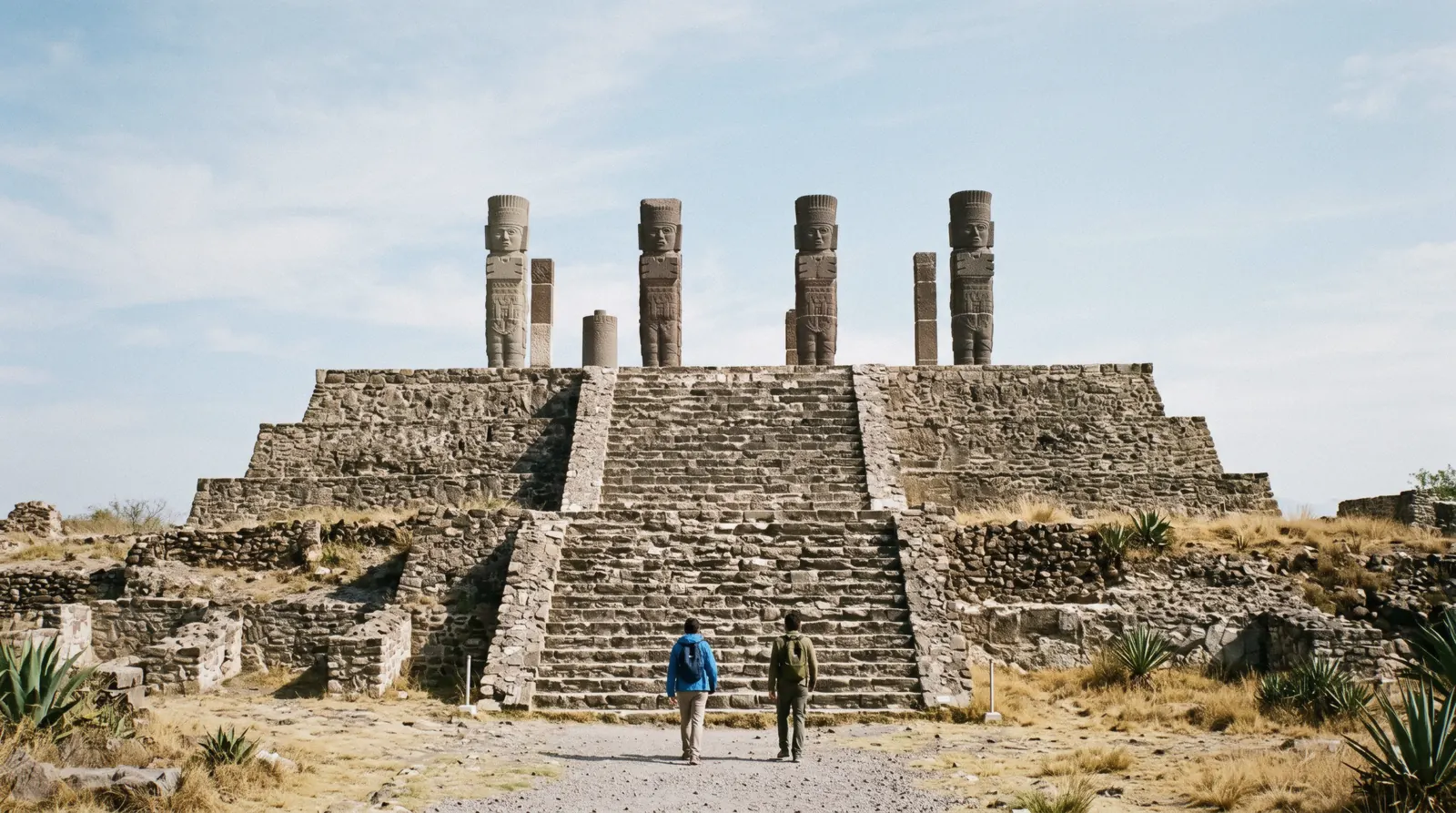
Tula And The Atlantes
The Tula archaeological site, 70 kilometres north of Mexico City and about an hour and a half by road, was the Toltec capital — the city the Mexica later claimed as their civilised ancestors. The reason to make the trip is on top of Pyramid B: four basalt warriors, four metres tall, that once held up a temple roof. The zone opens daily 09:00 to 18:00 with last entry at 16:30, and the site museum is included. Prices and hours read on 30 August 2026.
Quick answer What is there, how far, what it costs
Tula is the Toltec capital 70 km north of Mexico City, about 1 hour 30 by road, and the reason to go is the four basalt Atlantean warriors standing four metres tall on the main pyramid. The zone opens daily 09:00–18:00 with last entry at 16:30, and entry is MX$210 for a foreign visitor and MX$105 for nationals and residents.
Key takeaways
- The Atlantes are the whole point: four carved warriors on Pyramid B, and the best surviving Toltec sculpture anywhere
- It opens every day, which puts it alongside Teotihuacán as a Monday option
- The site museum, Jorge R. Acosta, is included and holds the ceramics and reliefs from the excavation
- It is smaller and far less visited than Teotihuacán — if you have seen one pyramid site and want another, this is it
- Which pyramid day to take first is set out on the Mexico City city guide
What It Costs
INAH's 2026 tariff for the zone, read on 30 August 2026 and converted at US$1 = MX$17.0.
| Option | Price | Includes | Cancel | Book |
|---|---|---|---|---|
| INAH ticket at the gate | MX$210 foreign / MX$105 resident | The zone and the site museum | Not stated by INAH | Official site |
| Under-13s, disabled visitors, students and teachers | Free | The same | — | Official site |
Sundays are free for Mexican nationals and residents, as at every INAH site. No platform in this guide sells a Tula ticket.
Who The Toltecs Were, And Why It Matters Here
A short empire with a long afterlife.
Tula flourished between about 900 and 1150 CE, in the gap between the fall of Teotihuacán and the rise of Tenochtitlan, and it collapsed violently — the ceremonial centre was burned and the Atlantes were buried, which is why they survive. Its influence reached as far as Chichén Itzá in Yucatán, where the architecture repeats Tula's forms closely enough to have caused a century of argument about who copied whom.
For the Mexica, three centuries later, Tollan was the golden age: they claimed descent from the Toltecs, borrowed their iconography and used tolteca as a word meaning artist or craftsman. Standing here, an hour and a half from the Templo Mayor, is standing in the place the Aztec empire told itself it came from.
What Is Actually There
A compact site with one extraordinary thing on it.
Tula — Tollan to the Mexica — was the Toltec capital between roughly 900 and 1150 CE, the city the Aztecs later claimed as their civilised ancestor and whose name became a byword for artistry. What survives is a compact ceremonial centre: two pyramids, two ball courts, a colonnade and the coatepantli, a wall carved with snakes swallowing human figures.
The Atlantes stand on top of Pyramid B: four columns carved as warriors, four metres tall, in basalt, with butterfly breastplates and atlatls. They held up a roof that is long gone, and they are the single most reproduced pre-Hispanic sculptures after the Sun Stone. Standing under them takes ten minutes and is the reason for the journey.
The site museum, named for the archaeologist Jorge R. Acosta who excavated here, holds ceramics, reliefs and the explanatory material the open site lacks. It is included in the ticket and it is usually empty.
Getting There
Seventy kilometres north, and less served by tourism than the alternatives.
By road it is the Mexico–Querétaro motorway (57) with a turn for Tula de Allende, about 1 hour 30 without traffic. Coaches run from Terminal Central del Norte towards Tula through the day; local colectivos from the town centre pass the site entrance. Operators publish fares at the counter rather than in a form we could read.
Very few tours from Mexico City come here, which is both the drawback — you will probably be arranging it yourself — and the appeal: on a weekday the site can be nearly empty, which is never true at Teotihuacán.
When To Go, And What To Bring
An open site on a dry plateau, with almost no shade.
Mornings are the answer: the site opens at 09:00, the light on the Atlantes is best early, and the plateau is hot and exposed by midday in the dry months. From June to September the afternoon storms arrive as they do in the city, so an early start is a weather decision as much as a crowd one.
Bring water, a hat and sunscreen — at 2,000 metres on open ground the sun is stronger than it feels — and shoes that handle uneven stone. There is a small café at the entrance and the town of Tula de Allende, five minutes away, has restaurants around its own sixteenth-century monastery, which is worth twenty minutes if you have a car.
Tula Or Teotihuacán
They are not alternatives for a first visit, and here is why.
Teotihuacán is bigger by an order of magnitude, closer to the city, open every day and served by coaches every fifteen minutes. It is the one to take if you are choosing one. Tula is smaller, quieter, later in date, and has the Atlantes — which Teotihuacán has nothing like.
So: first pyramid site, Teotihuacán. Second, Tula. If you have five days and have already done Teotihuacán, this is the more interesting second choice than repeating a bigger version of the same visit.
Next Stop From Tula
Times by road on a weekday.
Tula Questions
What are the Atlantes de Tula?
Four basalt columns carved as Toltec warriors, four metres tall, standing on top of Pyramid B at Tula. They once held up a temple roof and they are the best-known Toltec sculptures in existence. What else is on the site is above.
How much does Tula cost?
MX$210 for a non-resident foreign visitor and MX$105 for Mexican nationals and residents under INAH's 2026 tariff, including the site museum. Under-13s, disabled visitors and students or teachers with credentials enter free; Sundays are free for nationals and residents.
What are Tula's opening hours?
Daily, 09:00 to 18:00, with last entry at 16:30 — which makes it one of the few archaeological sites open on a Monday, alongside Teotihuacán.
How do I get to Tula from Mexico City?
Coaches from Terminal Central del Norte towards Tula de Allende, about 1 hour 30, then a colectivo or taxi to the site entrance. By car it is the Mexico–Querétaro motorway. Few organised tours run here, so this is usually a do-it-yourself day.
Is Tula better than Teotihuacán?
Not better, and not a substitute: Teotihuacán is vastly bigger, closer and better served, and it is the one to see first. Tula is the quieter second pyramid site, and the Atlantes are something Teotihuacán does not have. The comparison is above.
Was Tula a Mayan city?
No. Tula was the Toltec capital in central Mexico, roughly 900 to 1150 CE, some 1,000 km from the Maya heartland. The confusion comes from Chichén Itzá in Yucatán, which repeats Tula's architecture closely enough that archaeologists argued for a century about which way the influence ran.
What artifacts were found at Tula?
Beyond the four Atlantean warriors: carved pillars and reliefs from the temple on Pyramid B, chacmool figures, ceramics, and the coatepantli — a wall carved with snakes swallowing human figures. Excavated skeletal remains and skull imagery from the site are part of the same iconography of sacrifice found across central Mexico. Most of the movable finds are in the site museum, which the ticket includes.
Where This Fits In A Trip
Day-trip pages are for the fifth day, not the first.
Tula belongs to a longer stay: with four days you take Teotihuacán, and with six or more this is the second pyramid day. It is also a Monday option, since it opens every day of the year. The day-trips page compares it with the alternatives, and the city itself is on the Mexico City city guide.
Page last reviewed 2026-08-30. Prices, hours and terms are set by the venue or operator and confirmed at checkout.
We may earn a commission if you book through one of our links, at no extra cost to you. Full affiliate disclosure